- Enugex Newsletter
- Posts
- SMR Readiness in Africa
SMR Readiness in Africa
Which countries are leading and which ones are falling behind?
Powering Africa’s Future: How SMRs Can Transform the Continent
In our first edition of the Enugex Newsletter, we introduced Small Modular Reactors (SMRs) as the next frontier of nuclear energy technology. Now, let’s explore what SMRs could mean for Africa’s energy future.
Africa faces a dual challenge: a rapidly growing population with increasing energy demand and a persistent energy access gap. SMRs offer a breakthrough solution—delivering clean, reliable power to both urban centers and remote regions. Unlike traditional large-scale reactors, SMRs are more affordable, quicker to deploy, and adaptable to smaller energy grids. This flexibility makes them particularly suited for countries with fragmented energy infrastructure, helping to bridge the divide between grid-connected cities and off-grid communities.
The adoption of SMRs could unlock a new era of industrialization across the continent. By providing consistent, low-carbon electricity, SMRs can power manufacturing hubs, support data centers, and enable critical infrastructure development—driving economic growth without the environmental toll of fossil fuels. As African nations work toward energy independence and sustainability, SMRs offer a pathway to leapfrog legacy energy systems and build a resilient, climate-conscious energy future.
The size of the prize…
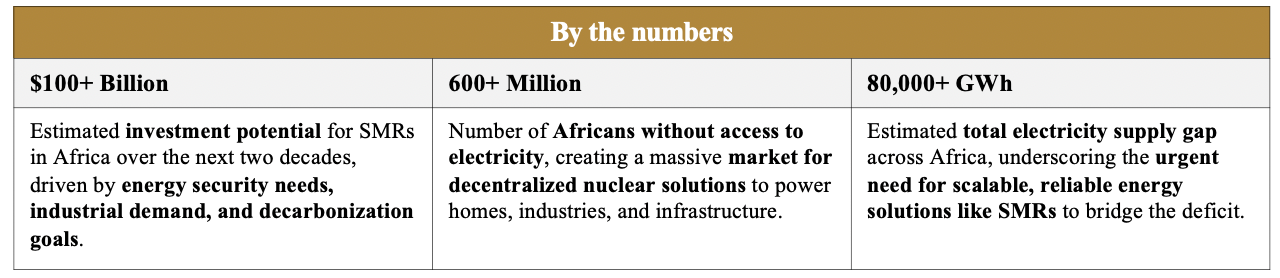
Africa faces both a pressing energy gap and a unique opportunity to leapfrog traditional energy infrastructure. The numbers below illustrate the scale of the challenge — and the opportunity — for SMRs to deliver reliable, scalable, and clean electricity across the continent:
Enugex’s SMR Readiness Score
To track Africa's journey toward embracing nuclear energy, Enugex has developed the SMR Readiness Score — a first-of-its-kind index measuring how prepared each African country is to adopt Small Modular Reactors.
Our scoring method produces a relative readiness score for all 54 African countries, based on key indicators such as energy demand, existing energy supply, off-grid population, government interest in nuclear energy, regulatory frameworks, and policy momentum. The score offers a snapshot of where each country stands today — and which markets are likely to lead the SMR revolution in the years ahead.
The Enugex SMR Readiness Score will be updated regularly as Africa's energy landscape evolves, serving as a guiding resource for policymakers, investors, and SMR manufacturers looking to enter the continent.
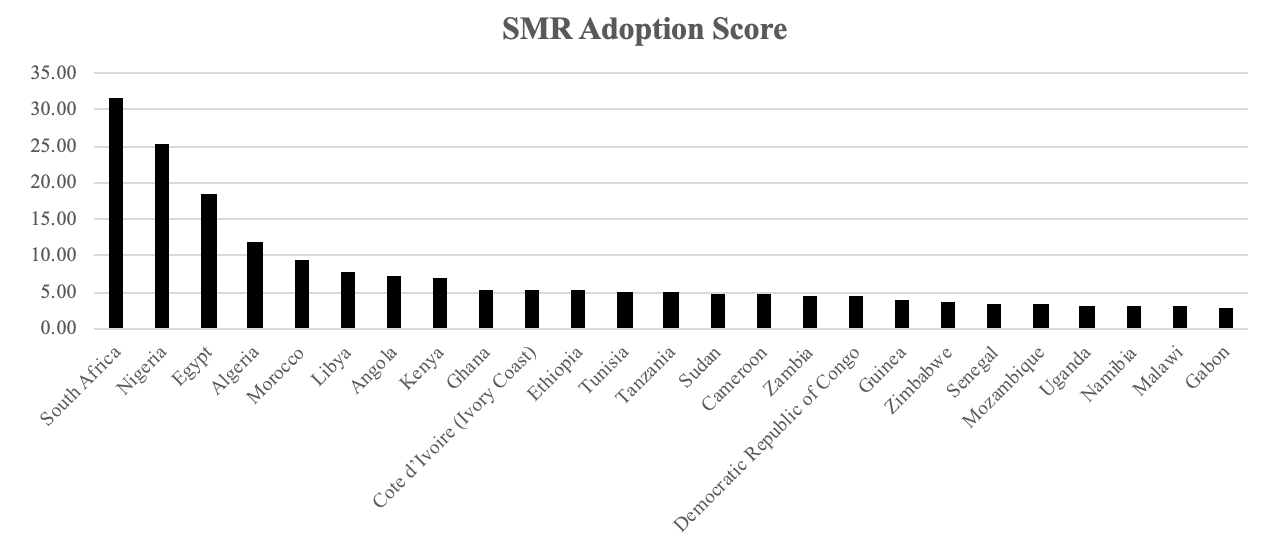
With an SMR Adoption Score of 31.67, South Africa is significantly ahead of other African nations. This aligns with its established nuclear infrastructure, including the Koeberg Nuclear Power Station, the only operational nuclear plant in Africa. The country’s existing regulatory framework and technical expertise position it well for small modular reactor (SMR) adoption.
Nigeria (25.25) and Egypt (18.50) follow South Africa in potential SMR adoption. Nigeria’s growing electricity demand, frequent power shortages, and interest in nuclear energy for industrial development contribute to its relatively high score. Egypt is already constructing the El Dabaa nuclear power plant in collaboration with Russia, indicating a strong nuclear policy foundation that could extend to SMRs.
The majority of African nations score below 10, reflecting significant barriers such as regulatory gaps, lack of nuclear infrastructure, and limited investment capacity. Countries like Morocco (9.33), Libya (7.75), and Kenya (6.94) have some level of nuclear ambition, but widespread political, economic, and technical challenges are slowing down their progress in SMR adoption.
Upon request, Enugex can release the full list of SMR Readiness Scores — offering a detailed view of how each African country ranks in its nuclear energy preparedness.
Country Spotlight: South Africa
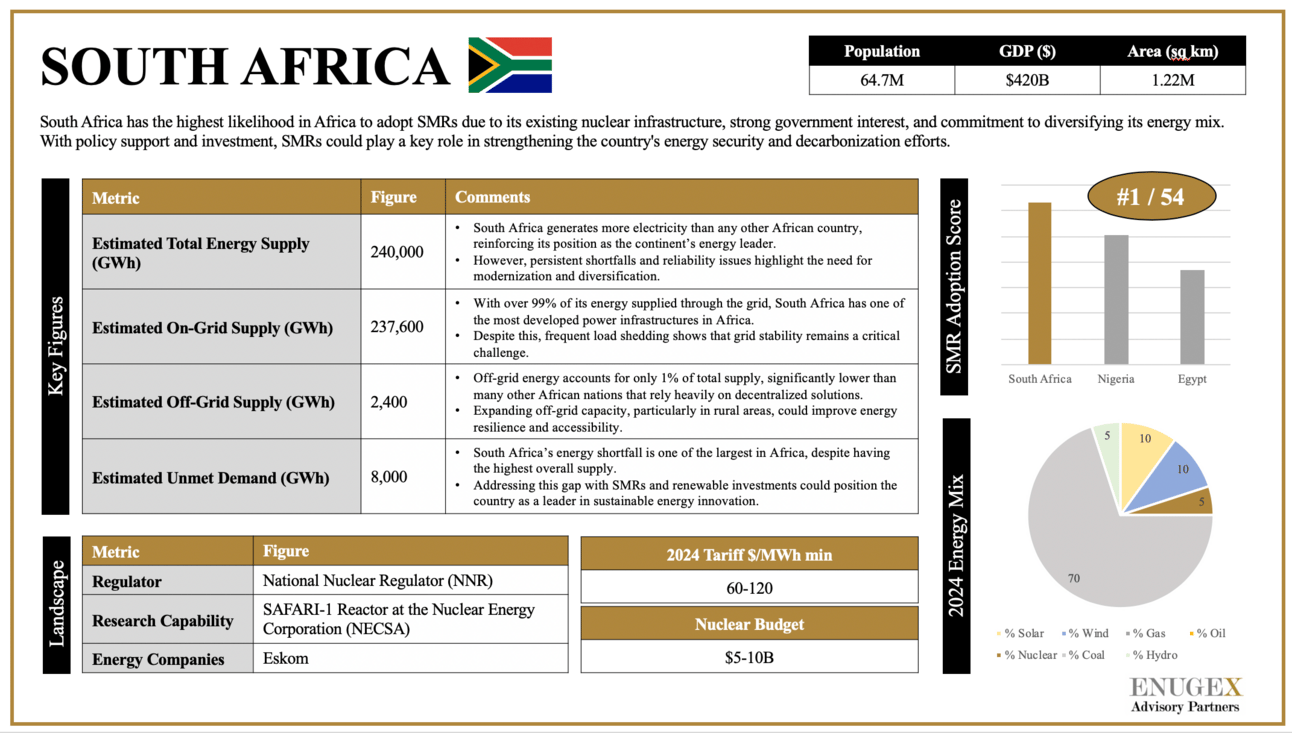
South Africa stands out as Africa's frontrunner in SMR adoption, with its long-established nuclear program and growing interest in next-generation energy technologies. As the only country on the continent currently operating nuclear power plants, South Africa is actively exploring SMRs to modernize its energy mix, reduce reliance on coal, and meet ambitious decarbonization targets.
The country’s Department of Mineral Resources and Energy has already issued requests for information on SMR technologies and signalled that SMRs will play a key role in its Integrated Resource Plan (IRP). With a supportive regulatory framework, a skilled workforce, and rising power demand, South Africa has the potential not only to deploy SMRs locally but to become a hub for SMR manufacturing and expertise across Africa — accelerating the continent’s nuclear energy revolution.
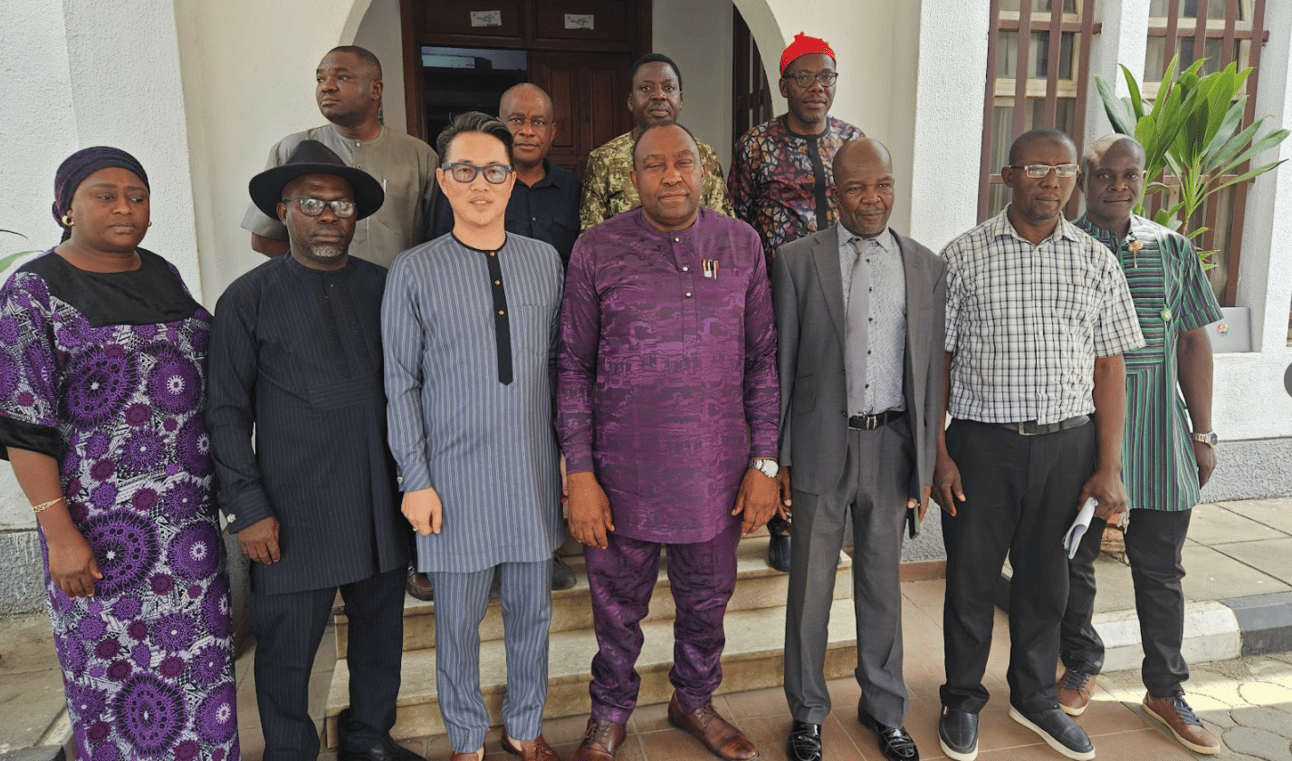
We went to Abuja this week
This week, Enugex Partner Yen Choi was in Abuja for a series of courtesy visits with the Nigerian Atomic Energy Commission (NAEC) and the Nigerian Nuclear Regulatory Authority (NNRA). These meetings are an important step in advancing the case for SMRs in Nigeria, fostering regulatory alignment and laying the groundwork for future deployment. Enugex remains committed to driving nuclear innovation across the continent—stay tuned for more updates.
Coming Up Next…
In our next edition, we'll explore SMR agreements to date across Africa — breaking down which countries have signed nuclear cooperation deals and what these agreements signal for the continent's energy future. We'll also feature Egypt in our country spotlight, highlighting its ambitious nuclear program and what role SMRs could play in meeting its growing energy needs.
Future editions will cover topics like off-grid electrification, regulatory landscapes, and energy mix diversification, with spotlights on Morocco, Nigeria, Ghana, Kenya, Algeria, and more — as we map Africa's nuclear energy journey.
Be in Touch
Contact one of our Partners, Mitch Kurylowicz ([email protected]), if:
You're interested in understanding how SMRs can transform Africa's energy landscape.
You're exploring partnership opportunities in the nuclear energy sector.
You need custom insights or data on SMR readiness in specific African markets.
You're seeking guidance on regulatory frameworks for nuclear energy projects.
You want to discuss investment opportunities in Africa's energy infrastructure.
We'd love to hear from you and explore how we can help you become part of Africa's energy future.